Nhận định trên được Neils Christensen - chuyên gia phân tích của Kitco News đưa ra trong bối cảnh lạm phát tại Mỹ vẫn dai dẳng, khi giá sản xuất tăng cao hơn dự báo trong tháng trước.
Theo thông báo của Bộ Lao động Mỹ công bố ngày thứ Sáu tuần trước, chỉ số giá sản xuất (PPI) toàn phần tăng 0,5% trong tháng 12, sau mức tăng 0,2% của tháng 11. Con số này cao hơn đáng kể so với dự báo của các nhà kinh tế, vốn chỉ kỳ vọng mức tăng 0,2%.
Tính trong 12 tháng qua, lạm phát bán buôn toàn phần tăng 3,0%, theo báo cáo.
PPI lõi – không bao gồm các mặt hàng có biến động mạnh như thực phẩm và năng lượng – tăng 0,7% trong tháng vừa qua, cao hơn nhiều so với mức dự báo 0,2% của thị trường, sau mức tăng của tháng 11. Dữ liệu PPI lõi theo năm cho thấy lạm phát ở khâu sản xuất đang dần “ăn sâu” vào nền kinh tế nói chung, với giá cả tăng 3,3%, trong khi các nhà kinh tế chỉ kỳ vọng mức 2,9%.
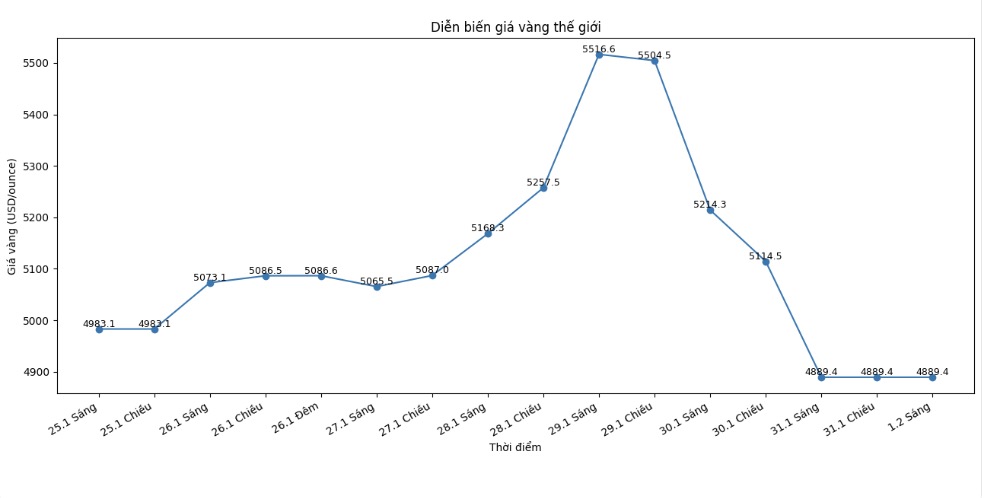
Tuần trước, thị trường vàng đã gặp khó khăn kể từ chiều thứ Năm, và số liệu lạm phát mới nhất đang làm gia tăng thêm áp lực. Giá vàng giao ngay lần cuối được ghi nhận ở mức 5.035,8 USD/ounce, giảm hơn 6% trong ngày. Hiện giá đã thấp hơn khoảng 10% so với mức đỉnh lịch sử trong phiên ngày thứ Năm là 5.600 USD/ounce.
Although the gold market has not reacted much to US interest rates recently, analysts believe that increased inflationary pressure may cause this traditional relationship to return. High production prices may force the US Federal Reserve (Fed) to maintain a neutral monetary policy longer than expected.
Earlier on Wednesday, the Fed decided to keep interest rates unchanged in the range of 3.50% – 3.75% and is forecast to continue to maintain a neutral stance at least until June. Fed Chairman Jerome Powell said that inflation risks are increasing and risks to the labor market are decreasing somewhat.
Neils Christensen emphasized that the current monetary policy of the central bank is in a suitable state, allowing the Fed more time to monitor economic activity throughout the period up to 2026.
Meanwhile, Mr. Sean Lusk - co-director of trade hedging at Walsh Trading - said that gold and silver prices are under pressure from the convergence of many unfavorable factors.
According to Mr. Lusk, the end of the month along with positive producer price index (PPI) data supported the USD to appreciate, thereby putting pressure on the precious metal group. In addition, the fact that Mr. Kevin Warsh (who was considered by US President Donald Trump to be nominated as Chairman of the US Federal Reserve) is considered a "hawkish" figure also disappointed the market, because many investors previously expected Mr. Kevin Hassett - who is considered more moderate - to be chosen. This development became an excuse for investors to boost profit-taking.
When asked about the main reason for the sell-off, Mr. Lusk affirmed that this was a consequence of the strengthening of the USD, not the internal weakening of gold and silver.
Today's developments completely revolve around the USD, associated with Mr. Warsh's choice," he said, while saying that expectations of a change in the'goose' direction at the Fed have not come true.
According to Mr. Lusk, the Fed is unlikely to adjust interest rates soon, regardless of who takes on the leadership role. This is what makes the sharp increase in precious metals in the middle of the week unsustainable, while paving the way for a deep correction at the end of the week.
He also noted that, from a technical perspective, the current correction is necessary, even if the market has been pushed too far in terms of supply and demand. However, he noted that the market may maintain an irrational state for a longer time than investors can bear.
Dù vậy, ông Lusk vẫn giữ quan điểm xu hướng dài hạn của giá vàng là đi lên. Theo ông, trong thời gian tới, các nhịp điều chỉnh nhiều khả năng sẽ tiếp tục thu hút lực mua, trừ khi xuất hiện cú sốc lớn như một đợt điều chỉnh mạnh trên thị trường chứng khoán.
“Biến động đã quá lớn và thị trường rõ ràng đang cần thêm những nhịp điều chỉnh” - ông nói - “Tuy nhiên, tôi cho rằng nhà đầu tư vẫn sẽ mua vào mỗi khi giá giảm”.
Theo ông Lusk, động lực nền tảng quan trọng nhất vẫn là việc các chính phủ tiếp tục nới lỏng tài khóa và làm xói mòn giá trị nợ công thông qua lạm phát, và yếu tố này chưa có dấu hiệu thay đổi.
Xem thêm tin bài liên quan tới giá vàng TẠI ĐÂY...